

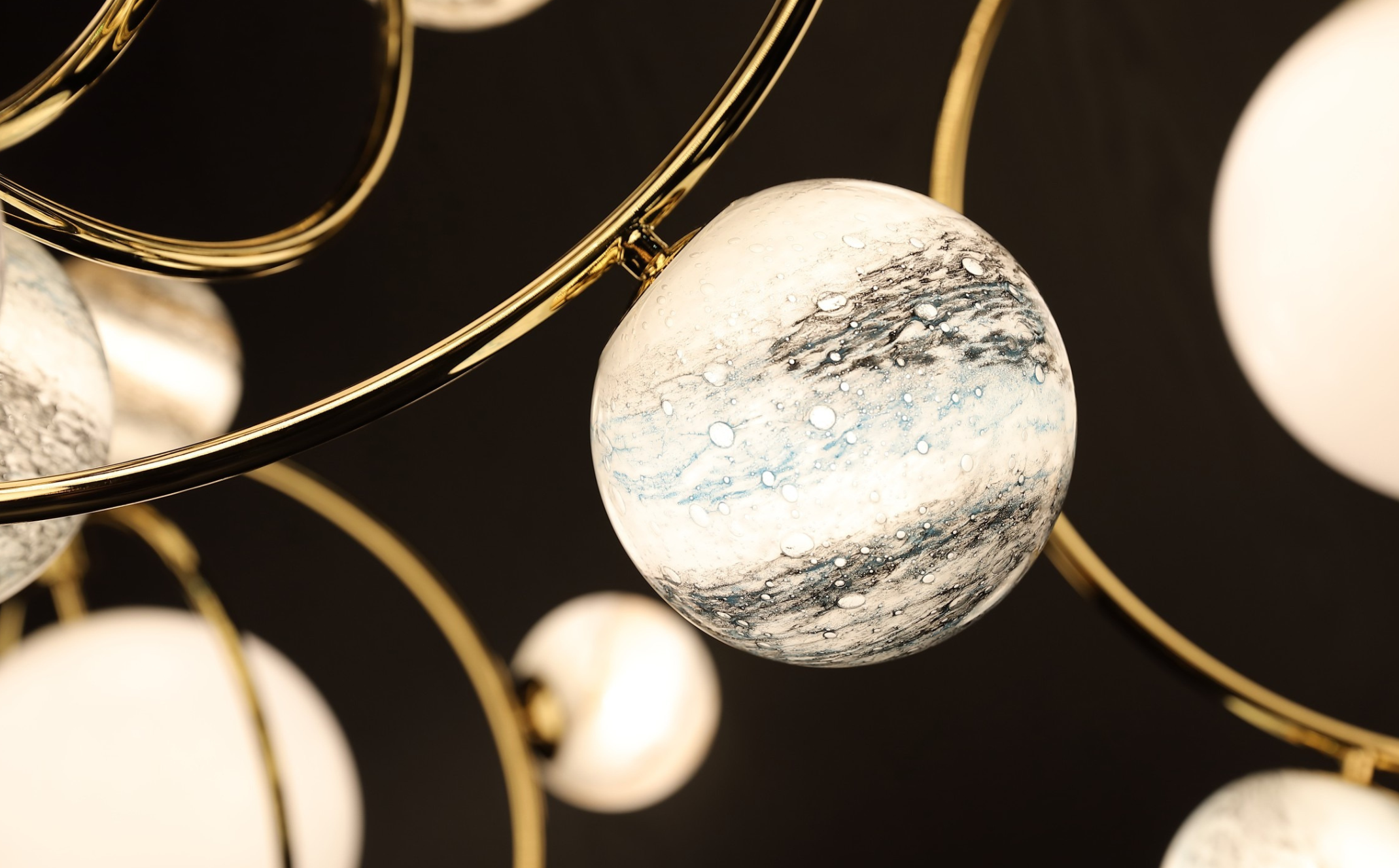
Some lights are designed simply to illuminate. Others allow light itself to become part of the architecture.
Inspired by planets and celestial orbits, the collection combines spheres with surface patterns reminiscent of planetary landscapes and slender metal rings, creating a sculptural composition of light suspended in space.
Interstellar – When Orbits Become a Design Language
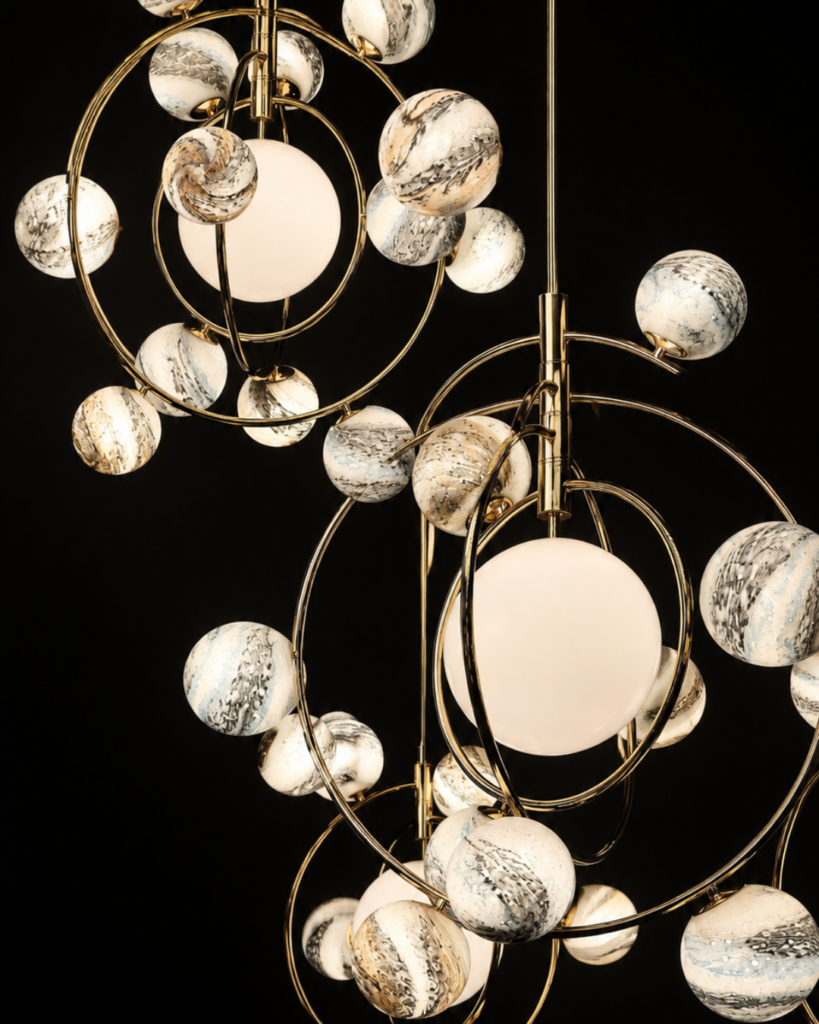
Rather than following the symmetry of a traditional chandelier, Interstellar is composed of intersecting metal rings, spheres of varying sizes, and a central source of light.
The curved lines act like orbital paths, while the spheres evoke planets moving around a luminous center.
Thanks to its layered structure, the fixture reveals a different character from every angle. This creates visual depth and a sense of movement, turning the piece into something to be explored rather than simply observed.
The Beauty of Handcrafted Glass
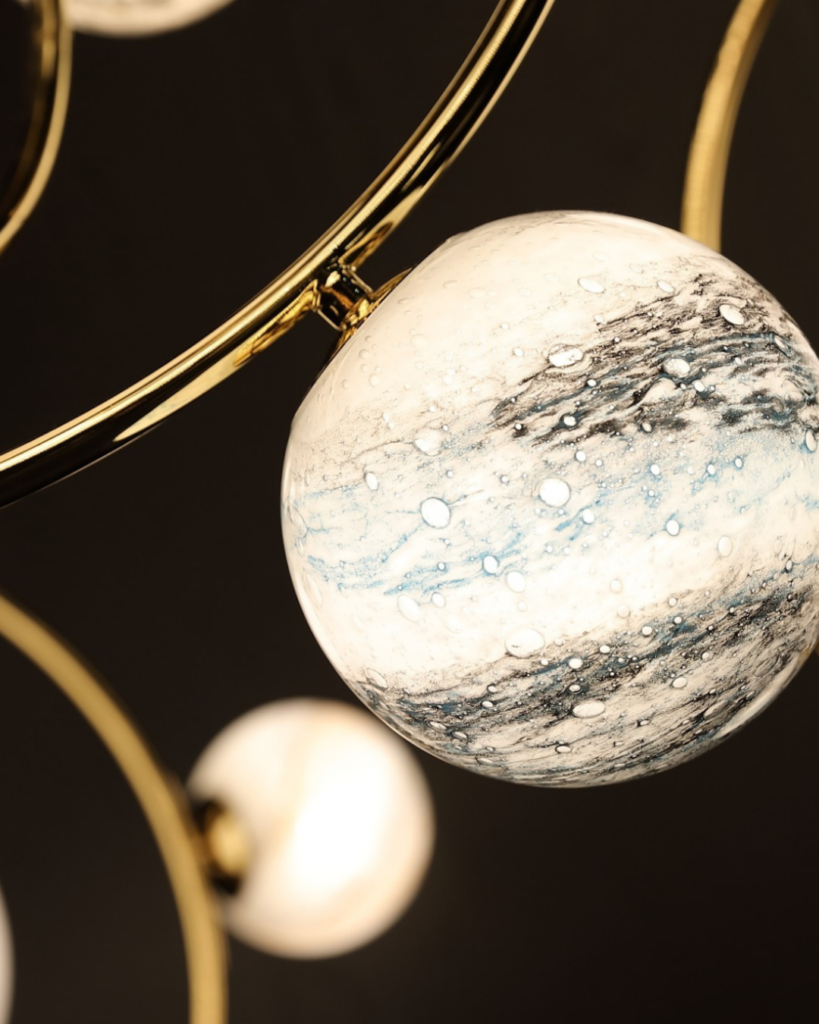
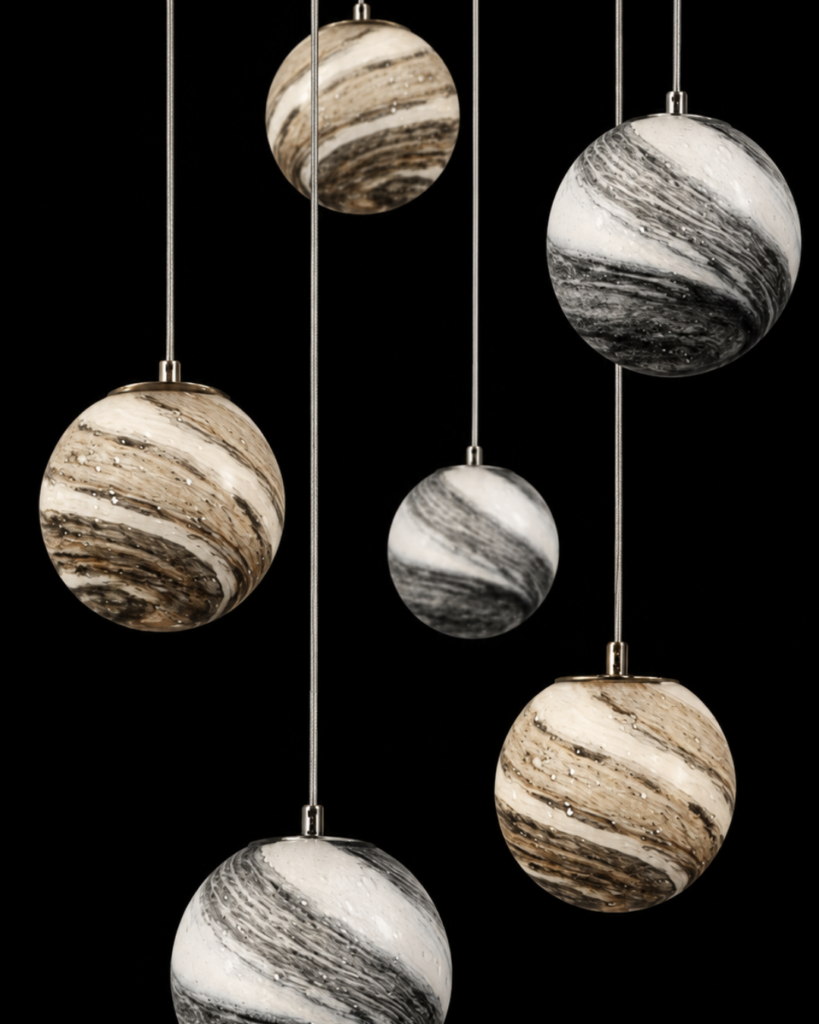
One of Interstellar’s most distinctive features is its spheres, whose textures resemble marble and planetary surfaces.
According to Marsden, these patterns are created through a combination of handcrafted glass and coloring materials, giving each sphere subtle variations rather than perfect uniformity.
When illuminated, the layered patterns become more pronounced, adding depth to the material and allowing each “planet” to function as an individual decorative element.
Interstellar Configurations
The Interstellar design language is developed across multiple configurations to suit different spatial scales.
Interstellar Chandeliers, featuring multiple light clusters, are ideal for double-height foyers, staircases, villas, hotel lobbies, and high-ceiling spaces. In these settings, the fixture can become an installation that visually connects vertical space.
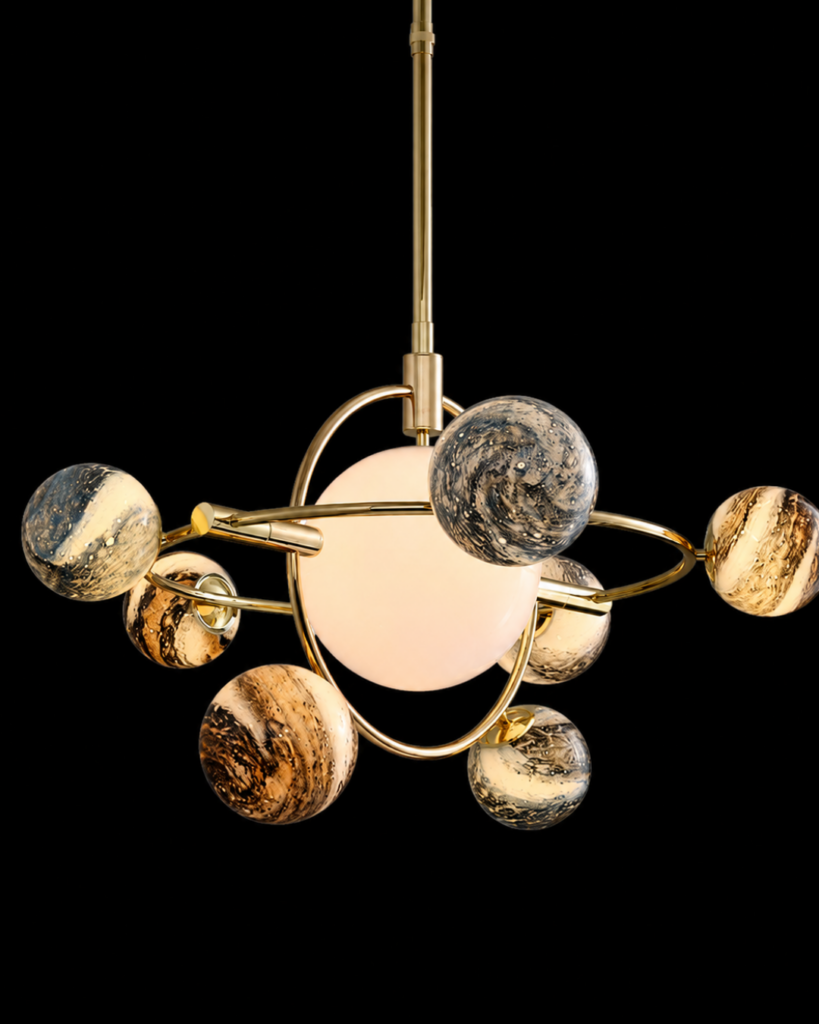
Interstellar Cluster Pendants retain the orbital rings and planetary spheres in a more compact proportion, making them suitable for living rooms, dining areas, lounges, and reception spaces.
Multi-Sphere Pendant Lights create rhythm through spheres suspended at varying heights, making them particularly effective above long dining tables, kitchen islands, or stairwells.
Interstellar Single Pendants offer the most minimalist interpretation. A single sphere can create a refined accent, while several pendants arranged at different heights can form an artistic lighting composition.
Why Does Interstellar Naturally Become a Focal Point?
Interstellar draws its visual impact from three elements:
Light creates the focal point.
Material creates depth.
Geometry guides the eye.
Together, they establish a distinct visual zone around the fixture. This is why Interstellar works especially well in spaces that call for a statement light—a feature strong enough to define character while remaining integrated with the architecture.
Beauty Is Not Enough – Proportion Matters
With premium decorative lighting, bigger does not automatically mean better.
The scale of a fixture should be considered alongside ceiling height, room dimensions, furniture proportions, and viewing distance.
A large Interstellar composition can work beautifully in a double-height space. In a more intimate living room or lounge, however, a smaller configuration installed at the right height can feel far more sophisticated.
Because in lighting design, the right proportion matters more than sheer size.
Interstellar in Interior Design
This collection works particularly well with Modern Luxury, Contemporary, and modern Art Deco interiors.
Brass-toned metal can complement marble, dark wood, and refined finishes, while the fixture’s geometric structure is strong enough to become a focal point against a restrained architectural backdrop.
In villas, boutique hotels, and hospitality environments, Interstellar can also function almost like an art installation, helping create a distinctive spatial identity.
When Light Becomes Part of the Architecture
The value of a lighting fixture is not defined solely by its form.
When positioned at the right location and scale, lighting can emphasize height, create depth, establish visual hierarchy, and transform the way an entire room is perceived.
That is where the difference lies between a decorative light fixture and true lighting design.
At Peakrockgreen, we approach lighting as an integral part of the interior, where proportion, materials, color temperature, installation height, and architectural language need to work together.
With a design such as Marsden Interstellar, the question is not simply:
“Is this light beautiful?”
The more important question is:
“What will this light do for the space?”
Explore more solutions in decorative lighting, interior design, and the art of illumination at peakrockgreen.



Comments (0)
Please sign in to leave a comment